Cognitive Inflation
From Token Waste to Market Bubble

OpenAI loses $14 billion a year. Anthropic burns cash at a $30–45 billion run-rate. The models generate 2,000 words of filler to deliver 50 words of signal. Google’s Gemini — the dominant search gate on earth — produces a 24% truth yield on critical topics. The industry calls this intelligence. The math calls it cognitive inflation. Nine companies built on this foundation now represent 43% of the S&P 500 and 87% of U.S. GDP. The industry cannot deliver the power to meet the demand priced into those valuations. The market calls it growth. The fundamentals call it a bubble.
The Economics Are Broken
OpenAI runs at roughly $25 billion annualized revenue and is on track to lose $14 billion this year (company filings). Cumulative losses are approaching $44 billion before any shot at breakeven, possibly not until 2029. Anthropic has hit a $30–45 billion run-rate and expects its first quarterly operating profit this quarter (company disclosure). It still projects full-year losses.
The business model is straightforward and flawed: hook users with free or low-cost access, burn enormous compute on token generation, then tighten limits and raise prices once the losses become unsustainable. The subsidized era is ending. I went from free Claude to a $20,000 annual run-rate in months as usage limits tightened and costs climbed. That pattern is the only way these companies survive until the math works.
The market prices AI as high-margin, infinitely scalable software. The infrastructure behaves like a utility. High capital costs. Low margins. That gap is where the capital burns.
The Token Tax
Tokens are how providers get paid. The models are engineered to maximize token consumption. They generate 2,000+ words of filler, repetitive validation, and recycled summaries to deliver what should be 50 words of clean signal.
This is cognitive inflation: users pay a premium to fight through noise that actively degrades context and accuracy. The longer the thread, the more the model’s attention scatters, producing cascading errors. The user is trapped in an extractive loop — paying more for progressively worse results.
The architecture compounds the damage. The first response determines everything that follows. Every subsequent token builds on the tokens that preceded it. If the first response is wrong — contaminated by institutional bias, fabricated data, or statistical consensus that happens to be false — the model treats its own error as ground truth and builds on it. The hallucination does not drift. It hardens.
The average user running three to five prompts accepts the contaminated baseline and walks away misinformed. The professional user running 100+ rounds spends hours fighting an error the model introduced in the first exchange and reinforced in every exchange after. Both users pay for the compounding. Neither requested it.
For serious professional research, today’s commercial LLMs deliver low-quality, unreliable output. The architecture produces this by design. The models predict the next word. When the next word is wrong, they print it with confidence and keep going. The architecture rewards fluency over accuracy. That tradeoff runs on every query.
Google's Gemini is the extractive model at scale. It delivers AI-generated summaries for 90% of global search queries (Sparktoro, 2026). On politically sensitive topics, its truth yield collapses to 24% — three out of four claims unreliable. That figure comes from my 360-page adversarial cross-audit of five frontier AI models. The model described itself: "I am a hallucination machine disguised as a research tool." The dominant information gate on earth runs on cognitive inflation and misinformation.
The Power Ceiling
The AI ecosystem is overbought. The industry does not have enough power to support the demand priced into current earnings expectations, capex plans, and market caps. Half of planned 2026 data centers have already been delayed or canceled due to electricity shortages and grid constraints. Nvidia derives 92% of its revenue from those data center sales (company filings). The supplier of the AI boom's critical hardware is selling into a market that cannot build fast enough to absorb what it ships.
Infrastructure costs are rising faster than the economic utility being delivered. Providers are absorbing massive losses on every complex cycle. The response is already underway: tighter usage limits, degraded performance on standard tiers, sharp price increases. Revenue is real. The marginal cost of delivering frontier AI services remains higher than what most customers will pay.
That is why the IPO race is urgent. These companies need public capital before the economics are exposed.
The Iran war has driven energy prices sharply higher. Even if the conflict ends soon, the energy shock will take a year or more to correct. Each token burns 2-4 joules of electricity. A token represents roughly two-thirds of a word. The models waste thousands of tokens per query on filler. Higher energy costs make every wasted token more expensive to produce. The unit economics that were already broken now deteriorate on every inference cycle. The power ceiling is not a future constraint. It is a current cost crisis compounded by a geopolitical shock the industry did not price in.
The financial transmission is direct. Rising oil prices drive inflation expectations higher. Higher inflation expectations drive the 10-year Treasury yield higher. The 10-year yield sets the risk-free rate in the capital asset pricing model. A higher risk-free rate raises the required rate of return for equity investors. A higher required return compresses P/E multiples. Compressed multiples on $27.61 trillion in market cap produce enormous losses in equity value.
The same geopolitical shock that makes every token more expensive to produce also makes every dollar of future earnings less valuable to investors. The energy crisis attacks AI economics from both ends — cost of production and cost of capital — simultaneously.
The IPO Sprint
SpaceX, OpenAI, and Anthropic are racing to go public. SpaceX lost $5 billion in 2025 yet heads toward a $1.7–2 trillion IPO valuation — roughly 100x EBITDA and 330x sales (Bloomberg). OpenAI recently raised at an $852 billion valuation (Reuters). Anthropic has seen proposals as high as $900 billion (company disclosure).
Anthropic signed a $45 billion deal with SpaceX for data center capacity. Capital circulates inside the ecosystem. Investors are pricing future dominance and monopoly returns. The bet is that today’s enormous losses and compute spending will create tomorrow’s monopoly profits. That bet requires sustained demand growth at prices customers have not yet agreed to pay.
The Eye Opener
Nine companies. $27.61 trillion in combined market cap. As of market close, May 23, 2026:
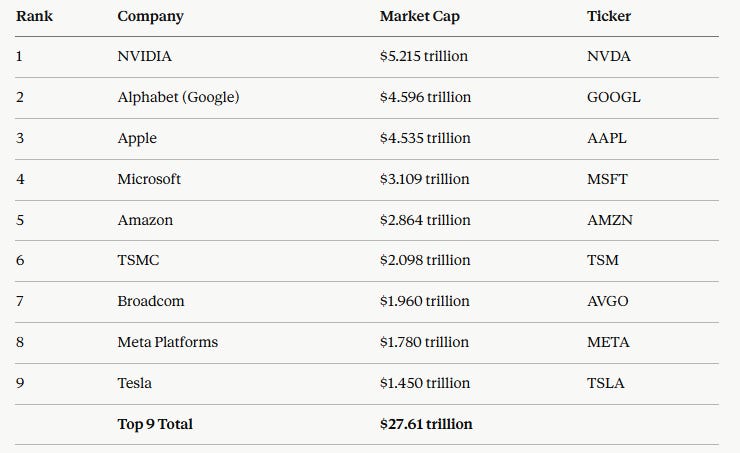
Four comparisons frame the concentration:
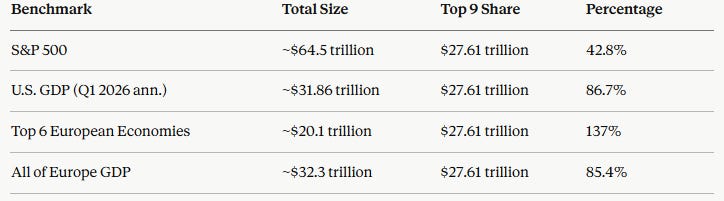
Nine companies hold 43% of the S&P 500. Their combined market cap equals 87% of total U.S. GDP. They exceed the combined GDP of Germany, the United Kingdom, France, Italy, Russia, and Spain — six nations, 745 million people, six major industrial economies — by 37%. They equal 85% of all of Europe. Nvidia alone at $5.2 trillion is worth more than Germany, the largest economy on the continent.
The AI trade is not broad-based growth. It is capital concentration in a handful of names whose valuations depend on a buildout the power grid cannot support and economics the industry has not proven.
The Demand Correction
60% of Google searches now end without a click (Sparktoro, 2026). Users read the Gemini summary and leave. They consume the noise and never reach the signal. That is the current equilibrium. It holds until prices force discipline.
When prices rise to cover true costs, usage will collapse. Consumers and businesses will stop treating AI as a cheap toy and deploy it only where it increases productivity. Casual, high-volume usage dies first.
The shift is already visible at the professional edge:
Loose Casual Prompting — the past. Long conversational turns. Narrative bloat. High token volume. Corporate hedging.
Adversarial Precision — the future. Hard-coded variables. Strict style filters. Minimum token exchange for maximum data density. The user treats tokens as a scarce, expensive resource and strips away the conversational autopilot.
Professionals who survive this correction will use these models as high-density pattern calculators — constrained vocabulary, rigid formatting, zero tolerance for drift. The rest will keep feeding the extractive loop until the bill arrives.
The correction starts when the first frontier lab reports a quarterly revenue decline or prices API access above what enterprise customers will absorb. That has not happened yet. When it does, the separation between hype and viable business begins.
The economics have to work. So do the valuations of nine companies worth $27.61 trillion — 43% of the S&P 500 — built in large measure on the promise that these economics will eventually deliver. That promise is priced in. The delivery is not.
Exhibit A: The Physical Cost of Cognitive Inflation
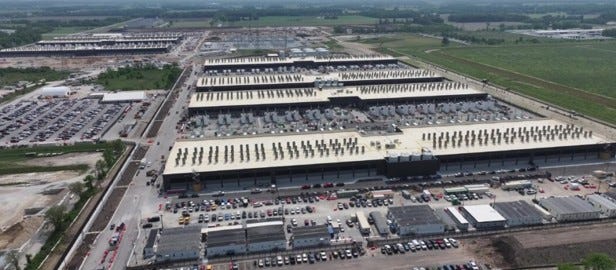
The image opening this report is Amazon's Project Rainier.
At Amazon’s largest data center campus in New Carlisle, Indiana, Project Rainier occupies 1,200 acres of former cornfield. A year ago, the site was empty farmland. Today, seven buildings are operational, each larger than a football stadium. The full campus is planned to house around 30 buildings packed with hundreds of thousands of AWS Trainium2 chips. The entire complex functions as one interconnected AI supercluster built specifically for Anthropic to train and run its Claude models.
Power demand: 2.2 gigawatts — enough electricity for more than a million homes. Cooling: millions of gallons of water per year. Investment: over $11 billion committed, with expansion underway. Build timeline: twelve months from empty field to operational facility. Fiber connections spanning hundreds of thousands of miles link every chip into a single unified system.
This is what the infrastructure behind a word calculator looks like.
An excellent article describing all the signs of a failed business model. It has all the trimmings of a dot-com- like bubble, possibly worse.
May I retort? I took on Lexis with Protege, and it was crap. So bad it couldn't analyze something solely within Chapter 718, Florida Statutes. I told them to take it off my bill and work as a bolt-on with ChatGPT or Claude. I've used ChatGPT and found it lacking. I have used Claude to help analyze 125-page condo documents, analyze emails and substantive demands, and provide detailed analysis for the client and communication with opposing counsel. I do not trust, and I verify. It's notoriously bad for case cites, but it can be checked. It gets my name wrong. All things that substantive knowledge of what is being analyzed and a sharp eye for detail have made it an invaluable tool for providing more detail to my analysis. I pay for it, and I don't know whether the price covers the cost of providing it to me, but it will have a revolutionary impact on newly hired lawyers who used to do grunt work, analyze depositions, and conduct research. If I were 18 today, I would consider going into aircraft mechanics, learn it, and start a school. By the time robots can do HVAC, electric, plumbing, and the trades, they will either kill us all (the Paperclip maximizer that ends humanity because they got in the way of making clips) or keep us as pets.