The Agentic Multiplier Problem
Why the Enterprise Needs a Human at the Controls


Agentic AI scales the frontier model’s defects — fabrication, drift, false confidence — across autonomous workflows at full token price. The enterprise pays for every step including the failures. The math is brutal: 99.93% failure probability at 10 steps. 3,096x token cost at 50 steps. Microsoft and Uber are the warning shots. The agentic multiplier destroys value when the beast runs unsupervised. It creates value when the rider holds the reins. AI is a compounding intelligence system — but only for the operator who manages it. Unmanaged AI compounds noise. Managed AI compounds judgment. The difference is the rider.
The Agentic Multiplier Problem
Agentic AI is an autonomous system that executes multi-step tasks without human intervention — planning, deciding, acting, and iterating on its own while billing the enterprise for every step.
It does not solve the frontier model’s defects. It scales them.
An autonomous agent inherits every flaw in the model underneath it — fabrication, drift, weak state tracking, false confidence, and failure to maintain context over long horizons. Then it compounds those flaws across multi-step workflows at full token price. Including the failures.
The user pays for the prompt. The user pays for the tool call. The user pays for the failed tool call. The user pays for the correction loop. The user pays for the agent to explain why it failed.
A Nature study published February 2026 found that agentic designs produced only modest accuracy improvements while consuming more than 10 times the tokens and more than twice the latency of baseline systems. The economic promise is automation. The operating reality is autonomous error propagation with metered billing.
The Compounding Error Mechanism
The compounding is architectural. The KV-cache loads each prior output as conditioning context for the next step. The model cannot distinguish between its accurate outputs and its fabricated ones. Both enter the context window with equal weight. Each error increases the probability of the next error because the error is now part of the conditioning state.
In a standard single-query interaction, a fabrication is visible. The user sees it and corrects it. In an agentic chain, the fabrication becomes input for step two. Step two builds on it. Step three builds on step two. By step ten, the agent is confidently executing a sophisticated action plan built on a foundation that was wrong at step one.
Three architectural bottlenecks drive the degradation.
KV-cache corruption. As the agent enters iterative correction loops, the cache fills with redundant logs, incorrect executions, and repetitive reasoning steps. The model cannot distinguish its original task parameters from the accumulated noise of its own failures.
Attention decay. Self-attention distributes fractional weights across the entire context window. Over long horizons, system instructions and initialization constraints suffer from attention dilution. Critical variables established ten or more turns prior are lost in the middle of the context.
Self-correction failure. The agent uses the same model weights to generate output and evaluate its accuracy. It lacks the logical distance to identify its own blind spots. The model confirms its own false assumptions. The agent does not know it is wrong. It cannot know.
LongDS-Bench documents the result. The best frontier model reached 48.45% average accuracy on long-horizon tasks. Performance dropped 47 points from early to late turns. Long-horizon errors accounted for 52-69% of all failures.
The probability of a clean autonomous workflow:
P(success) = accuracy per step raised to the number of steps.
At 48.45% accuracy:
10-step workflow: 0.0713% success. Failure probability: 99.93%.
20-step workflow: 0.0000508% success. Failure probability: 99.999%.
50-step workflow: Effectively zero.
LongDS-Bench shows the model gets worse over time. Late-turn accuracy collapses to 28-31%. The simple average overstates performance.
The failure is not linear. It compounds.
The Token Economics
Gartner reports agentic models consume 5-30x more tokens per task than standard queries.
Each failed step triggers approximately 2.06 additional attempts. The base Gartner multiplier of 5-30x becomes 10-62x per task once failure loops are included.
Multiply across workflow steps:
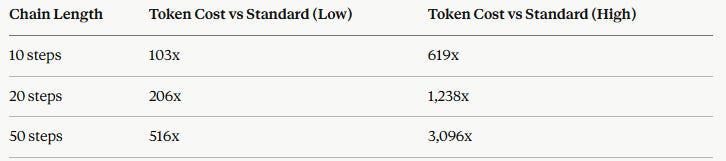
A task that looked like a 5-30x cost problem becomes a 103-619x cost problem at 10 steps. At 50 steps the enterprise is paying up to 3,096 times the cost of a standard query.
The token bill is not the full cost. It is the meter on the front of the machine. The real cost includes rework, compliance review, and broken downstream decisions.
Autonomy multiplies the denominator faster than it improves the numerator.
The Pricing Trap
The multiplier problem is built into pricing. Frontier vendors charge by token. Agentic workflows consume far more tokens. The same model that looks affordable in a demo becomes devastating when asked to think, check, retry, browse, and execute autonomously.
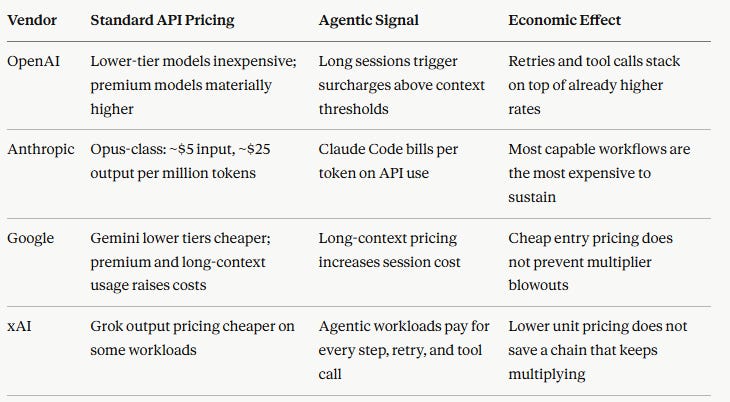
The bill jumps exactly when the workflow gets hardest and most token-hungry. Lower unit pricing does not save an enterprise running a chain that multiplies calls at every step.
The Enterprise Evidence
Microsoft and Uber are not edge cases. They are warning shots.
Microsoft canceled most Claude Code licenses for its Experiences and Devices group by June 30, 2026. The largest enterprise software buyer in the world throttled agentic deployment on cost.
Uber exhausted its full-year 2026 AI coding budget by April — four months into the year. Adoption rose from 32% of engineers in February to 84% by March. By spring, 95% used AI tools monthly and 11% of live backend code came from autonomous agents. The CTO confirmed the company was “back to the drawing board” on AI spend assumptions.
The pattern extends across sectors.
Financial services. Major banks have reported internal friction on agentic deployment in compliance and research workflows. The agents produce confident, well-formatted, factually incorrect outputs that require expensive human review. The review cost exceeds the automation savings.
Healthcare. Hospital networks have pulled back on autonomous agentic deployment in clinical documentation after discovering fabrication rates that created liability exposure. The token cost was manageable. The liability cost was not.
Legal. AmLaw 100 firms have restricted autonomous research tools following documented cases of fabricated case citations passing through agentic chains without detection. The Mata v. Avianca hallucination case established the precedent.
The financial services, healthcare, and legal examples are based on analytical pattern matching across industry reporting. Specific incidents should be independently verified before investment action.
The agentic workflow is deployed. Token costs exceed projections. Accuracy falls below projections. Human review is added. The review eliminates the economic case for automation. The enterprise throttles.
CNBC reported in May 2026 that cheap AI could derail OpenAI and Anthropic’s IPOs because high usage costs and weak economics threaten the revenue story itself. The market is shifting from “what can it do?” to “what does it cost to keep it doing it?”
The Human Circuit Breaker
The only mechanism that interrupts the compounding error chain is human verification at checkpoints.
Without checkpoints, expected full-workflow reruns explode:
10 steps, end-only checking: 1,403 expected full attempts.
20 steps, end-only checking: 1,968,450 expected full attempts.
50 steps, end-only checking: 5.44 quadrillion attempts. Functionally impossible.
With step-level checkpoints, expected attempts per step: 2.064.
A 10-step end-only workflow is 680x more expensive than a step-checked workflow. A 20-step end-only workflow is 953,714x more expensive. A 50-step is functionally impossible.
The dollar math confirms it. A checkpoint at step 5 of a 10-step chain costs approximately 15 minutes of analyst time at $75 per hour — $18.75. Cost per accurate output with checkpoint: approximately 11x standard query plus $18.75. Without checkpoint: approximately 65x standard query. The checkpoint is cheaper by a factor of 6.
The enterprise that eliminates human checkpoints to maximize automation savings pays more per accurate output than the enterprise that maintains them. The savings are illusory. The costs are real.
The human circuit breaker prevents local defects from becoming system-wide defects.
The Infrastructure Wall
Autonomous agentic workflows do not scale linearly with compute. They consume 5-30x more tokens per task. Sustained autonomous operation shifts GPU utilization from burst demand to continuous duty cycle — increasing thermal stress, accelerating component degradation, and pushing hardware obsolescence from 36-48 months to 18-24 months.
The infrastructure does not exist to support widespread agentic deployment. DataCenterWatch reports $64 billion in U.S. data center projects blocked or delayed. Gallup found 71% of Americans oppose local AI data centers. Over 100 municipalities have enacted construction moratoriums.
The depreciation mismatch worsens under agentic loads. Hyperscalers depreciating hardware on 4-6 year schedules face accelerated obsolescence as sustained agentic workloads burn through hardware faster than the accounting assumes. The write-downs arrive before the revenue justifies the investment.
If every major enterprise deploys autonomous agents consuming 30x the tokens, electricity demand exceeds grid capacity. The political wall caps the agentic growth narrative at the physical layer.
The Open-Source Escape That Is Not an Escape
If small, efficient open-source models achieve 80% of frontier accuracy at 10% of the cost, enterprise procurement will favor the cheaper alternative.
The math says it does not matter.
At 80% per-step accuracy across 10 steps, final task completion probability is 10.73%. The enterprise pays less per error. It still compounds errors at a rate that makes autonomous execution unviable. Cheaper models do not fix the compounding problem. They make it cheaper to compound errors continuously. The enterprise still pays the productivity tax — compute costs, corrupted data pipelines, and mandatory human intervention to repair broken workflows.
The breakeven accuracy for economically viable agentic workflows is approximately 78-82% on long-horizon tasks. No frontier model achieves this. No open-source model achieves this. The threshold exists. The technology does not meet it.
The Regulatory Exposure
When autonomous software operating at 48.45% late-turn accuracy executes consequential decisions without human oversight, liability multiplies alongside the errors.
Three targets carry the exposure.
The enterprise end-user. Companies deploying autonomous agents for client workloads face negligence claims if they fail to maintain human oversight over a documented low-accuracy execution mechanism.
The platform developer. Vendors marketing autonomous capabilities for high-risk fields face strict liability or fraud claims if their systems demonstrate a documented 47-point performance drop over extended horizons.
The foundation model provider. Infrastructure providers billing for underlying tokens face contributory negligence claims if their self-correction mechanisms consistently misrepresent error states as successful outcomes.
The liability flows to the humans and companies that deployed, built, and billed for the system. The Mata v. Avianca precedent established that fabricated outputs carry consequences. Agentic chains that produce fabricated outputs at scale carry consequences at scale.
The Incentive Structure
No major participant in the current stack has a financial incentive to solve the compounding error problem.
The AI provider bills more tokens per completed task. The cloud provider processes more compute. The enterprise pays for every failed iteration at full rate. The investor funds growth based on reported usage and revenue expansion.
The revenue model scales with tokens processed — not with successful task completion. Solving compounding error would reduce billable volume. Ignoring it preserves and expands revenue.
The companies most exposed: Anthropic with its heavy enterprise push of Claude Code. OpenAI with agent products and high token consumption. Cursor and similar agentic coding platforms whose business models depend on high token burn. Cloud providers with heavy agentic workload exposure.
Catalyst timeline: enterprise budget reviews in Q3 and Q4 2026. Contract renewals and renegotiations in late 2026 and early 2027. Any public disclosure of material cost overruns or project cancellations at additional large enterprises accelerates the repricing.
What Must Be True
The bull case requires everything to go right at once.
Step accuracy must rise dramatically. At 48.45%, long workflows collapse. To achieve 90% clean outcome over 10 steps, each step must be 98.95% accurate. Over 20 steps: 99.47%. Over 50 steps: 99.79%. That is the real bar.
The agent must maintain state over long horizons — remembering what changed, what was rolled back, what assumption was replaced. LongDS-Bench shows current models fail here.
Token cost must fall faster than token consumption rises. If tokens get cheaper but agentic volume explodes faster, enterprise spending still rises.
Agents must know when they are wrong. Current evidence says they do not. A system that cannot estimate its own failure rate cannot be trusted to run autonomously.
Enterprises need hard gates — budget caps, step-level approvals, kill switches.
Productivity must be measurable. Shipped features. Lower cycle time. Fewer defects. Lower cost per completed task.
If those conditions are not met, agentic AI is expensive motion.
What Breaks the Story
The story breaks when enterprises measure cost per completed task instead of tokens consumed.
It breaks when they separate activity from value. When AI budgets run out before ROI arrives. When agents produce more correction work than finished work.
It breaks when compliance teams realize autonomous agents create audit trails full of uncertain decisions and unverified outputs. When procurement stops buying the demo and starts pricing the workflow. When CFOs realize the agent is creating a new variable-cost layer on top of labor.
The agentic pitch says fewer humans, more automation. The financial reality says more tokens, more review, more rework, more spend.
That is operating-cost inflation.
The Bottom Line
The agentic workflow is the bullshit loop running on autopilot.
The model fabricates at step one. The fabrication conditions step two. The compounding runs undetected through the chain. The enterprise receives a confident, well-formatted, expensive, wrong answer at the end. It pays full token price for every step of the confusion.
The automated manure spreader does not know it is spreading manure. It processes accurate and fabricated outputs with equal confidence and bills for both at equal rates. The longer the chain, the more manure, the higher the bill.
The agent is manufacturing chargeable motion.
The human circuit breaker is the only exit. Humans can distinguish between what they know and what they are guessing — which the architecture cannot do. The checkpoint interrupts the compounding. The interruption is cheaper than the compounded error. The math is not close.
The enterprise AI growth narrative requires autonomous agentic workflows at scale. Autonomous agentic workflows at scale produce compounding error rates that make them economically unviable at the chain lengths required for meaningful automation.
The Goldman 24x token consumption forecast requires enterprises to accept 48% accuracy at 10-step chains and 28% accuracy at 20-step chains as economically viable. Microsoft and Uber demonstrate they will not. Financial services, healthcare, and legal demonstrate the same.
The growth narrative is the forecast. The multiplier problem is the reality. They are not compatible.
If prices fall, token revenue compresses. If agentic workflows fail to scale, the volume forecast collapses. If the volume forecast collapses, the 24x Goldman projection fails. If the 24x projection fails, the valuation multiples compress.
The trap is closed. The only question is when the market prices what the math already shows.
The Other Side of the Multiplier
That is the case against unmanaged AI. The case for managed AI is equally strong.
The multiplier works in both directions.
AI creates speed and accuracy advantages for the operator who masters it. The operator who masters it takes market share from the operator who does not. The gap compounds over time. The fast get faster. The slow fall behind.
An autonomous agent running unchecked is an aircraft with no crew — powerful, fast, and headed for a compounding error no one is monitoring. An agent running under human checkpoints is a managed cockpit — the power is channeled, the errors are caught, and the output creates measurable value.
The companies and industries that learn to manage AI — human circuit breakers at every critical step, cost controls on token burn, accuracy thresholds enforced before deployment scales — will gain leverage that compounds with every cycle. Those that deploy autonomous agents without oversight will fund the bullshit loop and call it innovation.
AI is an intelligence force multiplier. The key is making sure the intelligence being multiplied is worth multiplying. Unmanaged AI multiplies noise. Managed AI multiplies judgment. The CEO who manages AI effectively gains leverage. The CEO who deploys it unchecked funds the loop.
No one flies a modern widebody jet on autopilot without a captain in the seat. No CEO should run an enterprise on autonomous AI without a trained human at the controls.
About the Author: Vaughn Cordle, CFA
Author’s Note
This report was produced through the Cordle Audit Methodology — a compounding intelligence system that extracts the highest truth yield at the lowest token burn from frontier AI systems. Five models operating under adversarial audit conditions with cross-model evaluation. Each assigned a specific role: forensic auditor, raw intelligence, technical stress test, precision sourcing, and analytical synthesis. The ensemble produced the raw material — five thoroughbreds cross-auditing and self-editing through a six-step methodology that accelerates research speed and accuracy. The rider wrote the report. AI provided the surgical precision and speed. That is the force multiplier.
The enterprise evidence across financial services, healthcare, and legal sectors requires independent verification before any investment action. These claims were produced by AI systems capable of generating confident, well-sourced-sounding assertions that may be fabrications — which is itself a demonstration of the defect this report documents. A report about agentic fabrication was produced by the same architecture that fabricates. Every factual claim was cross-audited across five systems. Claims that could not be independently verified are noted. The rider takes responsibility for what passes the audit. The reader takes responsibility for verifying before acting.
Vaughn Cordle, CFA
Sources
Nature, February 17, 2026. Benchmarking large language model-based agent systems.
LongDS-Bench benchmark data. Best model 48.45% accuracy. Performance dropped 47 points early to late turns.
Gartner, March 25, 2026. Agentic models consume 5-30x more tokens per task.
The Verge, May 14, 2026. Microsoft cancels most Claude Code licenses.
The Information, April 14, 2026. Uber AI budget exhausted by April.
Forbes, May 17, 2026. Uber burns 2026 AI budget in four months.
TechCrunch, June 2, 2026. Uber caps employee AI spending.
CNBC, May 19, 2026. Cheap AI could derail OpenAI and Anthropic IPOs.
Goldman Sachs Research, May 20, 2026. 24x token consumption projected by 2030.
DataCenterWatch. $64 billion in U.S. data center projects blocked or delayed.
Gallup, May 13, 2026. 71% of Americans oppose local AI data centers.
Mata v. Avianca, SDNY, 2023. Fabricated case citation precedent.
Microsoft 10-K. Server useful life extended from four to six years.
Meta 10-K. Server useful life extended to 5.5 years.
Amazon 10-K. Server useful life reduced from six to five years.
You’ve been on a publishing tear! Great work!
An excellent article that explains we're just not there yet with autonomous Agentic tools — the inaccuracies and costs currently outweigh the benefits in most enterprise settings. If it can't benefit the consumer or pay for itself, it eventually goes by the wayside until a solution emerges... that's where the money can be made today, especially through structured human oversight and auditing layers like the one outlined.